Bayyinat Academy
Prophet Yusuf’s Story for Children: Quran Reading and Questions
The story of Prophet Yusuf, peace be upon him, begins with a dream he tells his father. It moves through separation, trials and prison, then responsibility and reunion. We read Surah Yusuf to understand the account given in the Quran, not to fill gaps with invented scenes.
This is a short family-reading retelling, not the Quranic text or a substitute for reading the surah and studying its explanation. Links beside each stage open the relevant passage. Choose how much to read and explain with a parent or teacher, according to the child’s understanding.
Request a free trialMeet the teacher and discuss a plan, with no commitment to subscribe.
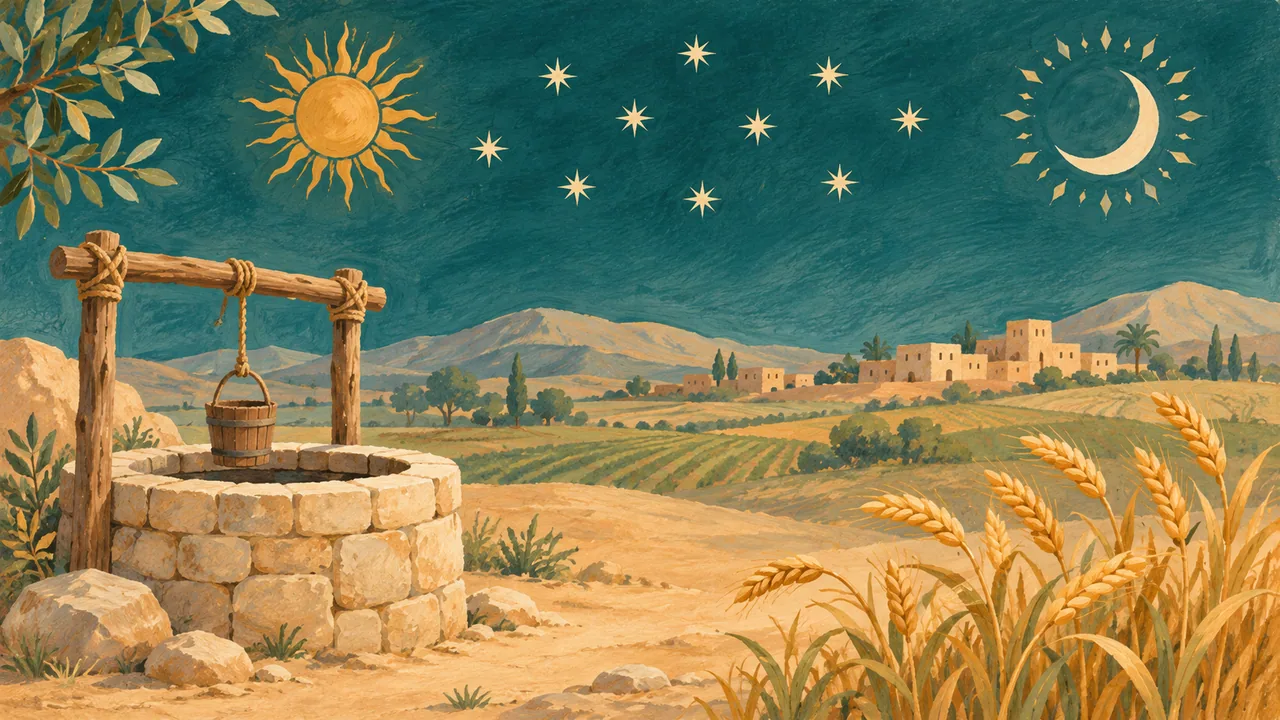
Yusuf’s dream and his father’s advice
Yusuf told his father Yaqub, peace be upon them both, that he had seen eleven stars, the sun and the moon prostrating before him. His father told him not to relate the dream to his brothers, lest they plot against him, and spoke of Allah’s favour in choosing and teaching him.
Begin with Surah Yusuf, verses 4–6. Ask: who had the dream, and whom did he tell? This account is not a method for interpreting a child’s own dreams. The verses describe what Allah taught Yusuf.
Separation and the well
Yusuf’s brothers took him away and placed him in the hidden depths of the well. They returned to their father weeping, claiming that a wolf had eaten him, and brought his shirt with false blood. Yaqub did not accept their account; he sought Allah’s help and chose beautiful patience.
A caravan then arrived. Its water-drawer lowered his bucket and found Yusuf. Read verses 15–19, rather than inventing the well’s depth, the length of his stay, or words he spoke that the passage does not report.
Ask: was the brothers’ account to their father what had really happened? Let the child point to the reading instead of acting out a frightening scene or imagining Yusuf being harmed.
The journey to Egypt
The verses describe Yusuf being sold for a small price, then the man in Egypt who bought him telling his wife to treat him well. When Yusuf reached maturity, Allah granted him judgement and knowledge.
Read verses 20–22. Explain his arrival in Egypt within what the text tells us. Do not supply an exact age, physical appearance or the man’s name from imagination. The accompanying artwork is not a map of a verified historical location.
Seeking Allah’s protection, then prison
In the household where he lived, Yusuf was invited to wrongdoing and sought refuge in Allah. The surah later describes him being imprisoned despite the signs of his innocence. A parent or teacher should explain this passage appropriately without unnecessary detail or changing its meaning.
Refer to verse 23 and verses 33–36. In prison, two young men asked him about their dreams. Yusuf explained that his knowledge came from his Lord, called them to worship Allah alone and told them the interpretation. Read this part with the teacher in verses 36–42.
Do not present the story as a promise that hardship ends on a timetable we choose, or ask children to treat every event as a rule for interpreting their dreams or personal circumstances.
The king’s dream and preparing for hard years
The king saw seven fat cows being eaten by seven lean ones, and seven green ears of grain and others that were dry. The surviving prison companion remembered Yusuf and went back to ask about the dream.
Yusuf explained the coming seven years of cultivation, followed by seven difficult years, then a year of relief and rain. He advised leaving the harvest in its ears, apart from the small amount needed for food. Read verses 43–49.
Ask: did Yusuf only describe the years, or did he also explain what to do with the harvest? A child can arrange cards labelled “cultivation,” “storing the harvest” and “hard years” to review the account. The cards are a reading activity, not additional facts about the story.
Innocence established and responsibility entrusted
When the king sent for Yusuf, Yusuf first requested an inquiry into the incident concerning him so that the truth would become clear. The wife of Al-Aziz acknowledged what she had done. The king then described Yusuf as trusted and established in position, and Yusuf asked to be placed in charge of the storehouses, describing his ability to guard and manage them.
Read verses 50–56. Keep the explanation within what the passage establishes about his position and responsibility. Do not add a coronation, an invented title or extra dialogue.
The brothers return and Yusuf reveals his identity
Yusuf’s brothers came to him. He recognised them, but they did not recognise him. They later returned with his brother, whom Yusuf received and told who he was. The surah explains how his brother remained with him and what followed. Read this arrangement in context with a knowledgeable teacher; do not summarise it as the brother actually having stolen.
The passages are verses 58–60 and 69–82. After the brothers returned home, Yaqub’s grief deepened, but he brought his sorrow to Allah and told his sons to seek news of Yusuf and his brother without despairing of Allah’s relief. Read verses 83–87.
When Yusuf revealed himself, his brothers acknowledged their wrongdoing. He responded with forgiveness, as related in verses 89–92. Discuss that response as part of the account, not as a demand that a child conceal harm or stop seeking protection and help.
The shirt and the family reunion
Yusuf told his brothers to take his shirt to their father and bring the whole family to him. When the shirt was placed on Yaqub’s face, his sight returned. His sons asked him to seek forgiveness for them, and he promised to ask his Lord to forgive them.
The family then reunited in Egypt. Yusuf reminded his father of his earlier dream and Allah’s favour towards him, and the passage includes his prayer to his Lord. Read verses 93–101. The prostration mentioned in verse 100 needs explanation from its tafsir and context; it is not an activity for children to act out or a ruling for them to derive themselves.
Questions after reading
Return to the verses when you need to check. This is not a race to recall events.
- What did Yusuf see at the beginning of the story?
- How did the brothers’ actions differ from their account to their father?
- How did the caravan find Yusuf?
- To whom did Yusuf attribute his knowledge?
- What did he advise about the harvest before the difficult years?
- Did the brothers recognise Yusuf at their first meeting?
- How did Yusuf respond when his brothers acknowledged their wrongdoing?
- What earlier event did Yusuf remind his father of at the reunion?
Suggested answers and references
- Eleven stars, the sun and the moon prostrating before him — verse 4.
- They placed him in the well, then claimed a wolf had eaten him — verses 15–18.
- The water-drawer lowered his bucket and found him — verse 19.
- He attributed it to his Lord’s teaching — verse 37.
- Leave it in its ears, except a small amount for food — verse 47.
- Yusuf recognised them, but they did not recognise him — verse 58.
- He forgave them and prayed for their forgiveness — verses 91–92.
- He reminded him of his first dream — verse 100.
After the comprehension questions, keep reading together with Prophet Sulayman’s story for children. Pick one question from the new story and ask your child to find the verse that supports their answer.
A simple family reading sheet
| Field | What the reader notes |
|---|---|
| Passage read | Surah name and verse numbers. |
| An event I can summarise | One sentence in my own words, not presented as the Quran’s wording. |
| Evidence for my answer | The verse number I checked. |
| A question I still have | A question for the teacher instead of a guessed explanation. |
Copy the table onto paper if useful. This is an optional discussion activity, not an academy placement test or fixed homework requirement. Tafseer lessons address verse meanings, while Islamic Studies includes stories of the Prophets among its subjects.
For the distinction, read Seerah or stories of the Prophets?. For a child’s starting point, see our Islamic Studies guide. Request a free trial to discuss your reading goal and preferred teaching language with the team.
Reading sources and limits
The primary source is Surah Yusuf. The referenced passages were checked against Al-Mukhtasar fi Tafsir al-Quran while preparing this draft. The account above is a retelling, not a verbatim quotation or a complete translation of the surah. The questions are original activities, and the cover is symbolic: it depicts neither a Prophet nor a verified historical site.